Low Progesterone Symptoms After Ovulation (What Your Body Might Be Telling You)
If you’ve been told “everything is normal”… but something still feels off
You might be noticing things like:
spotting before your period
shorter cycles than expected
painful periods
being told you have PCOS, but not knowing when (or if) you’re ovulating
trying to conceive… but feeling like you’re guessing each month
And even when tests come back “normal”…
you’re left wondering:
“But then why isn’t this working?”
This is often where progesterone comes into the conversation —
but not always in a way that’s actually explained clearly.

Image by Karolina Grabowska on Unsplash+
What progesterone does after ovulation (and why it matters)
After ovulation, your body produces progesterone.
This hormone helps to:
support the uterine lining
stabilise your cycle
create an environment where implantation can occur
signal that ovulation has actually happened
But here’s the thing…
It’s not just about whether progesterone exists —
it’s about how well it rises, and how long it stays elevated for.
Signs your progesterone may be low after ovulation
These are some of the most common patterns I see in clinic:
1. Spotting before your period
Even 1–2 days of spotting can be a sign your progesterone isn’t holding strong.
This might look like:
brown spotting before your bleed starts
light bleeding that comes and goes
your “period” slowly starting over a few days
2. A short luteal phase (less than 12 days)
Your luteal phase is the time between ovulation and your period.
Ideally, this should be at least 12 days.
If it’s consistently shorter than this, it can mean:
progesterone isn’t staying elevated long enough
the uterine lining may not be fully supported
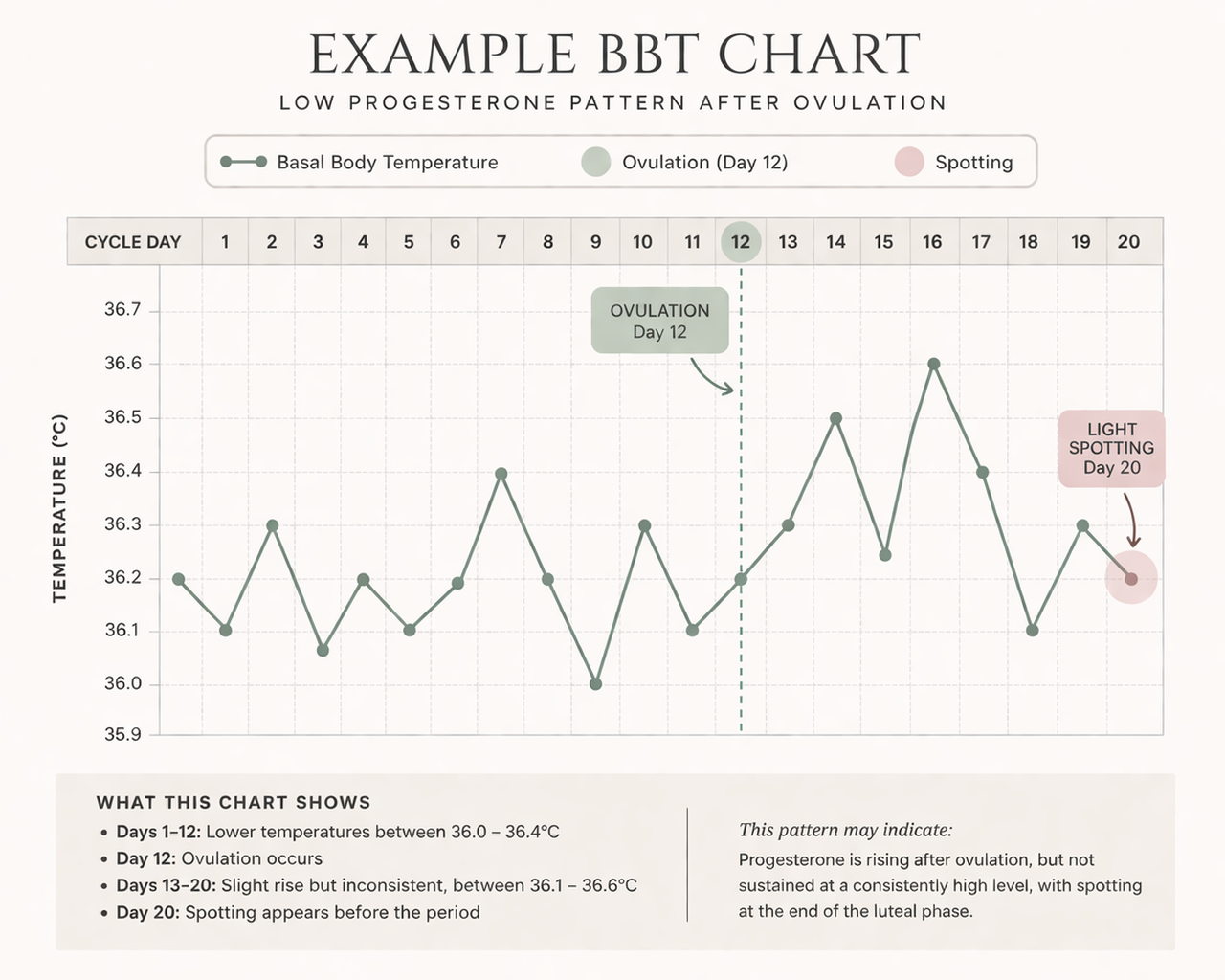
BBT chart showing temperature rise after ovulation with inconsistent luteal phase and spotting, indicating possible low progesterone
3. Your BBT chart doesn’t clearly rise after ovulation
When progesterone rises, your body temperature should rise with it.
On a BBT chart, we’re looking for:
a clear shift after ovulation
sustained higher temperatures
If your chart shows:
a slow or weak rise
temperatures that drop quickly
or no clear shift at all
…it can be a sign progesterone isn’t rising strongly.
4. Irregular cycles or difficulty knowing when to try
If ovulation is unclear or inconsistent, progesterone often is too.
This can show up as:
irregular cycles
not knowing when your fertile window actually is
5. Difficulty conceiving or early miscarriage
Progesterone plays a key role in supporting early pregnancy.
If levels aren’t optimal, it can impact:
implantation
early pregnancy stability
6. Physical and emotional symptoms after ovulation
Some people also notice:
mood changes, anxiety, or low mood
trouble sleeping
fatigue
breast tenderness
bloating or fluid retention
headaches
These can be subtle — but when they repeat each cycle, they matter.
“But my blood tests said everything is normal…”
This is something I hear all the time.
And it can be incredibly confusing.
Because “normal” ranges don’t always mean:
optimal for fertility
or reflective of how your cycle is actually functioning as a whole
This is why I don’t look at just one piece.
I look at:
your cycle patterns
your BBT chart
your symptoms
your blood work (in context, not isolation)
Because your body is always giving information —
it just needs to be understood properly.
This isn’t about diagnosing yourself
Reading this isn’t about jumping to conclusions or worrying that something is “wrong”.
It’s about starting to notice:
- what your body is already showing you
- what patterns are repeating each cycle
- where things may need a little more support
If you’re feeling unsure, this is a good place to start
If you’re sitting there thinking:
“This sounds like me… but I don’t fully understand what my cycle is doing”
I’ve put together a simple guide to help you start making sense of it:
It walks you through:
what to look for in your cycle
what your body may be telling you
how to start understanding things month by month
And if you’re ready for personalised clarity
If you don’t want to keep guessing…
This is exactly what I do inside my Fertility Clarity Session.
We look at your:
cycle
BBT chart
symptoms
blood tests
…and map out what’s actually going on —
so you can move forward with clarity instead of confusion.
Final note
You’re not behind.
You’re not missing something obvious.
Most people just haven’t been shown how to read what their body is already saying.
And once you understand that…
everything starts to feel a lot clearer.
Much love,
Zoe xx